VRF-Aware NAT & VASI
VRF-Aware NAT
Section titled “VRF-Aware NAT”VRF-Aware NAT is used to allow traffic from a VRF (usually a customer or internal VRF) to be translated before it enters the global routing table.
Why? Because:
- Traffic leaving a VRF must be NATed first, or else the global routing table won’t know how to route it (since VRF routes are isolated).
- When return traffic comes back, the NAT process reverses the translation before it re-enters the VRF — so it doesn’t get dropped in the global VRF due to a missing route.
This creates a clean edge between the VRF and the global routing table, using NAT as a handoff between them.
This NAT method requires the configuration of a route that points to an IP address that is not locally on itself. For NATing between VRFs without this limitation, use VASI if on IOS-XE.
Key Concepts
Section titled “Key Concepts”- The VRF has no direct routing knowledge of global, and vice versa.
- A static route using the
globalkeyword allows VRF traffic to exit toward the global next-hop. - NAT ensures return traffic is translated back into the originating VRF before routing decisions are made globally (dropping the traffic).
Configurations
Section titled “Configurations”interface GigabitEthernet0/0 description To-WAN ip address 10.0.0.2 255.255.255.252 ip nat outside
interface GigabitEthernet0/1 description To-LAN ip address 192.168.1.1 255.255.255.0 vrf forwarding INSIDE ip nat insidevrf definition INSIDE rd 1:1 address-family ipv4ip route 0.0.0.0 0.0.0.0 10.0.0.1
ip route vrf INSIDE 0.0.0.0 0.0.0.0 10.0.0.1 globalThe
globalkeyword enables traffic from the VRF to exit into the global space, assuming NAT occurs before it crosses the boundary. Without the following NAT configs, a ping could get out, but could not return, since you cannot have a route from Global pointing to a VRF.
access-list 1 permit 192.168.1.0 0.0.0.255
ip nat inside source list 1 interface g0/0 vrf INSIDE overload
Explanation:
- Traffic from
192.168.1.0/24(inside the VRF) gets NATed using the outside interface IP (g0/0). - NAT happens within the context of the
INSIDEVRF, ensuring translation occurs BEFORE hitting the global routing table. - Return traffic from the WAN will be translated back into the VRF BEFORE forwarding decisions are made by the Global VRF.
VRF-Aware Software Infrastructure (VASI)
Section titled “VRF-Aware Software Infrastructure (VASI)”On Cisco IOS XE, classical inter-VRF NAT is not directly supported. To perform NAT between VRFs, Cisco introduced VASI: VRF-Aware Software Infrastructure.
What is VASI?
Section titled “What is VASI?”VASI is a technique that enables inter-VRF NAT by creating VASI interface pairs:
- Each VASI interface is tied to a different VRF
- One is used as the inside NAT interface, the other as outside
- Packets are routed between them just like physical interfaces
- Example interface names:
vasileft1,vasiright1
VASI interfaces act as loopback-style virtual links, switching packets between two VRFs at Layer 3.
VASI is the supported method to implement inter-VRF NAT on IOS XE.
Configuration
Section titled “Configuration”In this example, we are NATing from VRF_LEFT to VRF_RIGHT only.
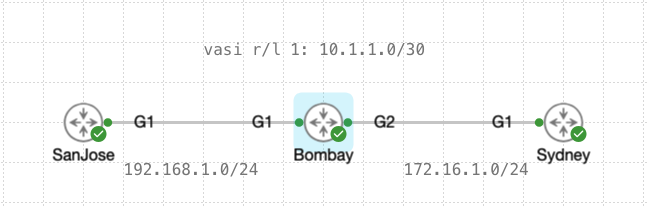
NAT on vasiright
Section titled “NAT on vasiright”Typical use case.
Most common scenario: the WAN or upstream-facing interface is part of VRF_RIGHT.
- Vasiright1 (in VRF_RIGHT) is the NAT inside
- GigabitEthernet2 (WAN-facing) is the NAT outside
interface GigabitEthernet1 vrf forwarding VRF_LEFT ip address 192.168.1.2 255.255.255.0
interface GigabitEthernet2 vrf forwarding VRF_RIGHT ip address 172.16.1.2 255.255.255.0 ip nat outside
vrf definition VRF_LEFT rd 1:1 address-family ipv4
vrf definition VRF_RIGHT rd 2:2 address-family ipv4interface vasileft1 vrf forwarding VRF_LEFT ip address 10.1.1.1 255.255.255.252
interface vasiright1 vrf forwarding VRF_RIGHT ip address 10.1.1.2 255.255.255.252 ip nat insideaccess-list 1 permit any
ip route vrf VRF_LEFT 172.16.0.0 255.255.0.0 vasileft1 10.1.1.2ip route vrf VRF_RIGHT 192.168.0.0 255.255.0.0 vasiright1 10.1.1.1
ip nat inside source list 1 interface GigabitEthernet2 vrf VRF_RIGHT overloadNAT on vasileft
Section titled “NAT on vasileft”In some designs, NAT is done entirely within VRF_LEFT, before sending traffic into VRF_RIGHT.
- GigabitEthernet1 (LAN-facing) is the NAT inside
- Vasileft1 (link to VRF_RIGHT) is the NAT outside
interface GigabitEthernet1 vrf forwarding VRF_LEFT ip address 192.168.1.2 255.255.255.0 ip nat inside
interface GigabitEthernet2 vrf forwarding VRF_RIGHT ip address 172.16.1.2 255.255.255.0
interface vasileft1 vrf forwarding VRF_LEFT ip address 10.1.1.1 255.255.255.252 ip nat outside
interface vasiright1 vrf forwarding VRF_RIGHT ip address 10.1.1.2 255.255.255.252
access-list 1 permit any
ip route vrf VRF_LEFT 172.16.0.0 255.255.0.0 vasileft1 10.1.1.2ip route vrf VRF_RIGHT 192.168.0.0 255.255.0.0 vasiright1 10.1.1.1
ip nat inside source list 1 interface vasileft1 vrf VRF_LEFT overload